Construction Cost Per Square Foot in Kerala: 2026 Pricing Guide
 Construction
Every homeowner planning a build in Kerala eventually asks the same question: what does construction actually cost per square foot in 2026? The honest answer is that it depends heavily on structural choices, finish quality, and site conditions, and a single flat number from a Google search rarely holds up once a real quote comes in. This guide breaks down what actually drives construction cost per square foot in Kerala this year, what a realistic budget looks like across quality tiers, and the hidden costs that most back-of-envelope estimates miss entirely.
Key Takeaways
This rate for 2026 typically ranges from roughly Rs 1,600 to Rs 2,800 plus per square foot, depending on finish quality.
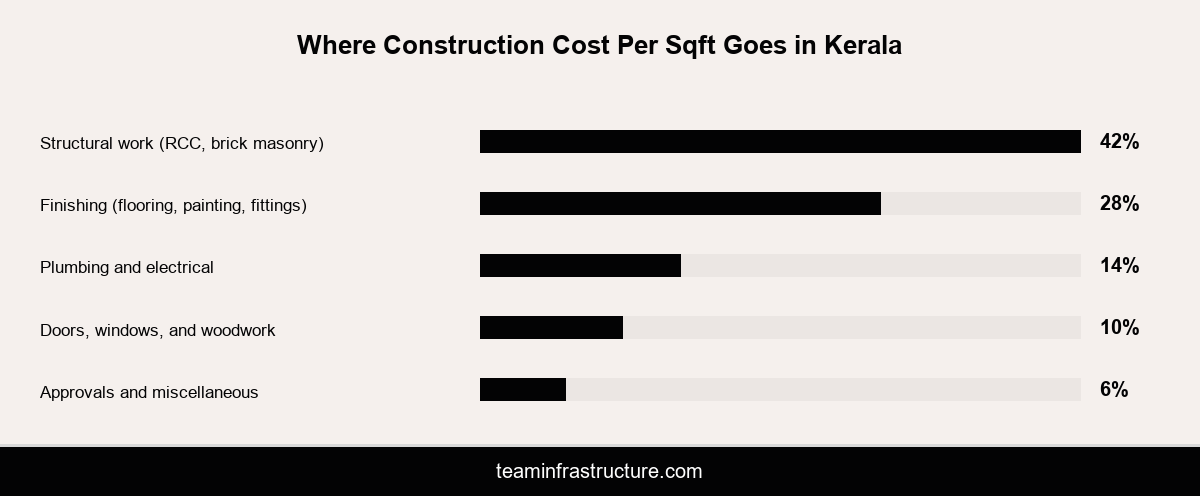
Structural work and finishing together account for around 70 percent of total build cost.
Hidden costs like soil conditions, utility connections, and approvals can add 10 to 15 percent beyond the quoted per-square-foot rate.
What Determines This Cost Per Square Foot in Kerala
The construction cost per square foot in Kerala is not a single fixed rate. It is the sum of several cost categories, each of which can swing significantly based on decisions made early in planning. Structural choices set the floor for the budget: foundation type, the grade of reinforced concrete used, and the number of floors all directly affect the base structural rate before a single finish is chosen. Finishing choices then layer on top of that structural base, and this is where cost per square foot varies most dramatically between a strictly budget build and a premium one. Site conditions matter more than most first-time builders expect. A plot with poor soil bearing capacity may need a more expensive foundation design, while a site with difficult vehicle access can increase labor and material transport costs meaningfully. Finally, civil construction firms in Kerala price differently based on team size, project management overhead, and whether supervision is priced separately from labor and materials, which is why two quotes for the same house plan can differ by 10 to 20 percent even before finish quality is discussed. Timeline also plays a quieter but real role in cost per sqft. A rushed schedule often means paying overtime rates for labor or accepting a smaller pool of available contractors, both of which push the effective rate higher than a project planned with a realistic, unhurried timeline. Seasonal timing matters too, since starting structural work right before Kerala's monsoon can force costly delays, temporary protection measures, and rework on any exposed material that gets damaged by rain before the roof is complete.
Structural Cost Drivers
Structural work, foundation, RCC columns and beams, and brick or block masonry, typically accounts for the largest single share of total construction cost, often around 40 percent. Foundation type alone can shift this substantially: a simple isolated footing foundation on stable soil costs far less than a raft or pile foundation required on poor or waterlogged soil, which is common in several low-lying areas of Kerala. Column and beam sizing, driven by structural design rather than aesthetics, also affects steel and concrete quantities directly, meaning a structurally conservative design from an overly cautious engineer can quietly inflate cost without adding any visible value. Steel reinforcement grade is another variable worth understanding before signing a contract. Fe500 and Fe550 grade steel cost more per tonne than older, lower-grade bars, but they allow a structural engineer to use less overall steel for the same load-bearing capacity, which can make the higher-grade option cost-neutral or even cheaper once total tonnage is accounted for. Cement grade follows a similar logic, where a slightly higher-grade cement used correctly in the right structural elements can reduce long-term maintenance costs tied to cracking or water seepage, even though the raw material cost per bag is marginally higher.
Finishing Cost Drivers
Finishing costs, flooring, painting, false ceiling work, bathroom fittings, and kitchen counters, make up the second-largest cost category and the one with the widest price range. Vitrified tile flooring at a budget grade costs a fraction of imported marble or large-format premium tiles, and this single choice alone can shift the overall per-square-foot rate by several hundred rupees. Bathroom and kitchen fittings follow a similar pattern, where branded fixtures at a mid-range price point deliver most of the durability of premium options at a meaningfully lower cost. Painting is often underestimated as a cost line item, particularly exterior painting, since Kerala's humidity and monsoon exposure demand weather-resistant exterior paint systems that cost considerably more than standard interior emulsion but last far longer against fungal growth and peeling. False ceiling work, increasingly common even in mid-range Kerala homes for hiding electrical conduits and adding lighting layers, adds a per-square-foot cost of its own that scales with how much of the home's ceiling area is covered, so a full-home false ceiling plan should be budgeted very differently from a few accent areas in the living room alone.
Average Construction Cost Per Square Foot in Kerala for 2026
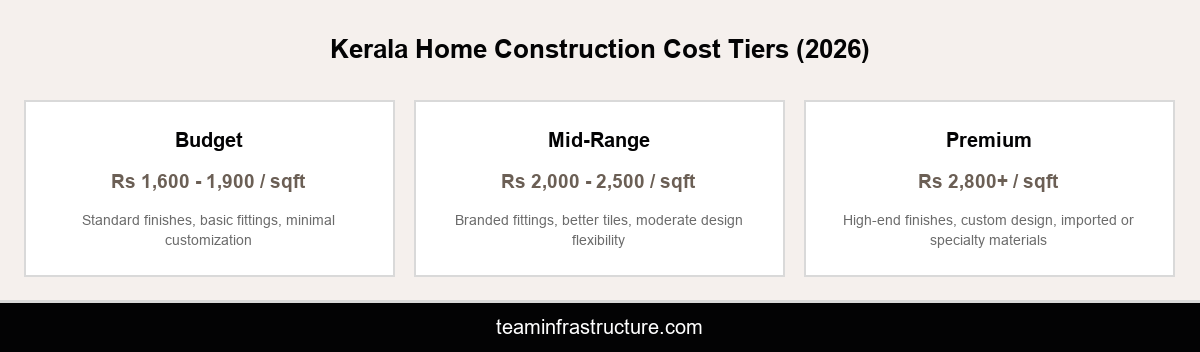
Based on current material and labor rates, this figure for 2026 generally falls into three broad tiers. Budget construction, using standard finishes and minimal customization, typically runs from around Rs 1,600 to Rs 1,900 per square foot. Mid-range construction, with branded fittings and better-grade tiles, usually falls between Rs 2,000 and Rs 2,500 per square foot. Premium construction, involving high-end finishes, custom design work, and sometimes imported materials, starts around Rs 2,800 per square foot and can climb considerably higher depending on specification. These figures assume a standard residential build without unusual structural complexity, and they typically cover structural work plus standard finishing, not interior furnishing or landscaping, which are usually quoted separately. It is worth noting these rates apply to a fairly standard rectangular or near-rectangular floor plan on a plot with reasonable access. Complex layouts with multiple curves, split levels, or unusual angles typically add 5 to 10 percent to the base rate simply because formwork and finishing become more labor-intensive around non-standard geometry. Multi-storey homes also shift the calculation slightly, since a second or third floor generally costs a little less per square foot than the ground floor, given that foundation and site preparation costs are largely fixed regardless of how many floors sit above them, spreading that fixed cost across more total built-up area.
Budget vs Mid-Range vs Premium Construction: What You Actually Get
Understanding what each pricing tier actually delivers matters more than the rate itself. A budget build at Rs 1,600 to 1,900 per square foot typically includes standard vitrified tile flooring, basic sanitary fittings, and minimal customization in layout or design, which suits homeowners prioritizing a functional home within a tight budget. A mid-range build at Rs 2,000 to 2,500 per square foot usually steps up to branded bathroom and kitchen fittings, better-grade tiles, and some design flexibility in layout, representing the tier most Kerala homeowners actually choose. Premium construction above Rs 2,800 per square foot brings genuinely custom design work, often through a dedicated architectural design process, along with high-end or imported materials and significantly more attention to detail in finishing. The gap between tiers is not just cosmetic. Mid-range and premium builds typically use better waterproofing, higher-grade electrical wiring, and more durable fittings that reduce maintenance costs over the home's lifetime, which is worth weighing against the higher upfront per-square-foot rate. Electrical wiring quality is a good example of a decision that is invisible once walls are closed up but expensive to fix later. Budget builds often use standard-gauge copper wiring sized to minimum code requirements, while mid-range and premium builds typically size circuits with headroom for future air conditioning or appliance loads, avoiding a costly rewiring job five or ten years later. Waterproofing follows the same pattern: a budget build may apply a single waterproofing coat to bathrooms and terraces, while mid-range and premium builds often use layered waterproofing systems with a longer warranty, directly reducing the odds of expensive seepage repairs during Kerala's heavy monsoon seasons.
Hidden Costs That Inflate the Per-Square-Foot Number
Most quoted construction cost per square foot figures cover core structural and finishing work, but several real costs sit outside that headline number and catch first-time builders off guard. A proper bill of quantities prepared before construction begins helps surface these costs early rather than discovering them mid-build, when negotiating leverage is much weaker. Homeowners who skip this step often end up 10 to 15 percent over their original budget simply because several real cost categories were never priced into the initial per-square-foot figure they were quoted. Contingency budgeting deserves its own line item rather than being treated as an afterthought. Even a carefully prepared estimate can miss a genuinely unpredictable cost, a sudden material price spike, an unexpected rock layer during excavation, or a design change requested partway through construction, and building in a dedicated contingency fund from the outset avoids the stress of scrambling for extra money mid-project.
Site-Specific Costs
Soil testing and foundation adjustments for poor bearing capacity, compound wall construction, utility connections for water and electricity, and site leveling or excavation for sloped plots are all commonly excluded from a base per-square-foot quote. On a difficult site, these costs alone can add a meaningful percentage to the total project cost, which is why an accurate estimate always requires an actual site visit rather than a generic rate applied to floor area. Access itself can be a surprisingly large cost factor in denser parts of Kerala. A plot reachable only by a narrow lane may require materials to be manually carried the last stretch rather than delivered directly by truck, adding labor cost that a generic per-square-foot rate never accounts for. Retaining walls for sloped sites, drainage work for low-lying plots prone to waterlogging, and tree removal or relocation are similarly site-specific costs that only become clear once an engineer or contractor actually walks the plot rather than reviewing it from a survey document alone.
Approval and Compliance Costs
Building permit fees, structural engineer certification, and compliance with local body setback and height regulations all carry real costs that are frequently quoted separately from construction itself. Skipping proper approvals to save money upfront is a false economy, since unauthorized construction can face demolition orders or heavy penalties later, costing far more than the compliance fees would have. Structural stability certificates, required for loan disbursement by most banks and housing finance companies, add another cost and timeline dependency that is easy to overlook when budgeting purely around construction materials and labor. Homeowners applying for a home construction loan should confirm exactly which certifications their lender requires and at what stage of construction, since some documentation needs to be generated mid-build rather than only at completion, and missing this timing can delay loan disbursement and, in turn, delay the construction schedule itself.
How Location Within Kerala Affects Construction Cost
Building cost in Kochi tends to run higher than in smaller Kerala towns, mainly due to labor rates, material transport distances, and land-related site constraints common in denser urban plots. Skilled labor, masons, electricians, plumbers, is generally more expensive in and around Kochi than in smaller towns, reflecting both demand and cost of living. Material costs are comparatively stable across the state for standard items like cement and steel, since these are distributed through similar supply chains, but transport costs for bulkier materials like sand and aggregate can vary based on how close a site is to a quarry or depot. Urban plots in Kochi also frequently carry higher site-preparation costs, since compact plots with limited access can complicate material delivery and require more careful, and more expensive, excavation and foundation work compared to a similarly sized plot in a less congested area. Ernakulam district as a whole tends to command a premium over inland districts like Palakkad or Kottayam, largely tracking overall demand and cost of living rather than any difference in material availability. Coastal proximity introduces its own cost factor regardless of district, since homes built close to the coast often need corrosion-resistant reinforcement and additional waterproofing to handle salt-laden air, a real cost that inland construction in the same district simply does not carry. Homeowners comparing quotes across different parts of Kerala should treat location-driven cost differences as a genuine input into their budget rather than assuming a single statewide per-square-foot figure applies evenly everywhere.
How to Get an Accurate Cost Estimate for Your Project
A reliable construction cost estimate starts with a finalized floor plan, since cost estimation before a design is locked is really just a rough guess. Once a plan exists, a detailed quantity surveying exercise, itemizing every material and labor component against the actual design, produces a far more reliable number than any generic per-square-foot rate. It is worth requesting this level of detail from any civil construction firm being considered, since a vague lump-sum quote without a line-item breakdown makes it difficult to compare offers fairly or identify where costs are being cut. Getting two or three detailed estimates using the same finalized plan is the single most effective way to validate whether a quoted per-square-foot rate is reasonable for the specific project, since it controls for design variables that make generic online rate comparisons unreliable. If an architect is involved in finalizing that plan, it is worth budgeting for their fees separately. Our architect fees in Kerala guide covers typical fee structures in more detail. Beyond the estimate itself, it helps to agree on a clear payment schedule tied to construction milestones rather than a flat monthly payment structure. Milestone-based payments, releasing funds as the foundation, structure, and finishing stages are each completed and verified, give homeowners meaningfully more leverage to address quality issues before releasing the next payment, compared to a schedule where money changes hands regardless of what has actually been completed on site.
Ways to Control Construction Cost Without Cutting Corners
Reducing construction cost per square foot does not have to mean reducing quality, if the right levers are pulled early. Simplifying the floor plan, favoring rectangular layouts over complex angular designs, reduces both structural complexity and material waste without any visible impact on livability. Choosing mid-range finishes strategically, spending more on high-visibility, high-use areas like kitchens and bathrooms while economizing on less critical spaces, delivers most of the perceived quality at a meaningfully lower cost. Locking material prices early through advance purchase agreements can also protect a budget from mid-project price increases, which are common given how much cement and steel prices can shift over a typical construction timeline. Coordinating structural and interior design decisions from the start, rather than treating interiors as an afterthought once construction is complete, also avoids costly rework like breaking finished walls to add wiring or plumbing points that should have been planned in from day one. Homeowners renovating an existing structure instead of building new face a different set of cost variables, covered in our guide to choosing a renovation architect in Kochi. Timing large material purchases around price dips, cement and steel prices in India do fluctuate seasonally, can also meaningfully reduce total cost for homeowners with enough schedule flexibility to plan purchases a few weeks ahead rather than buying reactively as each construction stage begins. None of these approaches require compromising on the structural integrity or long-term durability of the home. They simply require treating cost control as a planning exercise that starts before construction begins, rather than a series of reactive decisions made under time pressure once work is already underway. Reusing a proven, well-tested floor plan rather than commissioning a fully bespoke design from scratch is another underused lever, since a design that has already been built once has effectively had its structural and constructability issues worked out, reducing the risk of costly design revisions once construction is underway.
Conclusion
Construction cost per square foot in Kerala for 2026 depends far more on structural choices, finish tier, and site conditions than any single quoted rate suggests. Understanding what drives cost at each stage, and insisting on a detailed, itemized estimate rather than a flat per-square-foot number, is the clearest way to avoid budget surprises partway through a build. If you are planning a home in Kerala and want a realistic, itemized cost estimate based on your actual floor plan, book a consultation with TeamInfra's construction and architecture team.
Frequently Asked Questions
What is the average construction cost per square foot in Kerala for 2026?

It generally ranges from about Rs 1,600 for budget builds to Rs 2,800 or more for premium construction, depending on finish quality and design complexity.
Does construction cost per sqft include interior furnishing?
Usually not. Most quoted rates cover structural work and standard finishing only. Furniture, curtains, and decorative interior elements are typically priced and budgeted separately.
Why do two contractors quote different rates for the same house plan?
Differences often come from project management overhead, labor sourcing, material brand choices, and whether supervision is priced separately, not just raw material and labor cost differences.
Is building cost higher in Kochi than in smaller Kerala towns?
Generally yes, mainly due to higher skilled labor rates and site-preparation challenges common on compact urban plots, though standard material costs remain fairly consistent statewide.
What hidden costs are commonly left out of construction estimates?
Soil testing, utility connections, compound wall construction, and approval or permit fees are frequently quoted separately and often missing from an initial per-square-foot estimate.
How can I reduce construction cost without sacrificing quality?
Simplifying the floor plan, prioritizing spend on high-use areas like kitchens and bathrooms, and locking material prices early are effective ways to control cost without cutting real quality.
Should I get multiple construction quotes before starting?
Yes. Getting two or three itemized quotes based on the same finalized floor plan is the most reliable way to judge whether a quoted rate is fair for your specific project.
Does foundation type significantly affect construction cost?
Yes. Poor soil bearing capacity can require a more expensive raft or pile foundation instead of a standard isolated footing, meaningfully raising the structural portion of total cost.
How much should I budget beyond the quoted per-square-foot rate?
Many homeowners find it useful to budget an additional 10 to 15 percent above the quoted rate to account for site-specific costs, approvals, and minor design changes made during construction.
Can renovation costs be compared to new construction cost per sqft?
Not directly. A renovation often costs more per square foot than new construction, since existing-condition assessment and working around a finished structure typically add both design and labor complexity.