NRI Home Approvals in Kerala: POA, Permits and Local Help
 Renovation
The drawings are rarely the problem. The delays in NRI property construction approval Kerala owners face almost always come from coordination: a signature that needs the owner in person, a power of attorney that was never stamped, or a relative who is willing to help but not authorised to act. Each of these is avoidable with planning before the first application is filed.
This guide covers what a power of attorney can and cannot do in a build, how to choose a local coordinator, the permit flow through your local body, and the final approvals and connections. It is general information, not legal advice, and any power of attorney for your project should be drafted or reviewed by a lawyer.
Key Takeaways
- A power of attorney lets someone act for you only within the powers written into it, so draft one specifically for the build.
- Building permits come from the local body, whether panchayat, municipality or corporation, under the Kerala Panchayat or Municipality Building Rules.
- Choose a local coordinator for reliability and availability, and keep that role separate from the builder.
- Treat completion, occupancy, building number and utility connections as a second approval stage, not an afterthought.
- Keep a shared, organised document vault so nothing depends on one person's memory or one person's phone.
What a Power of Attorney Can and Cannot Do in a Build
A power of attorney is a document that authorises another person, the agent, to act on your behalf. For an NRI owner it is often the only practical way to sign forms, attend the local body office or deal with utilities while living abroad. The principle is simple. The drafting is where the risk sits.
For a build, owners typically consider a special power of attorney limited to specific acts: applying for the building permit and any renewal, signing and submitting plans prepared by a licensed professional, applying for completion and occupancy, applying for electricity and water connections, paying fees and taxes, and receiving certificates. That is a narrower and safer document than a general power of attorney covering all your property affairs.
What it should leave out matters just as much. A power of attorney for construction Kerala families use for a single home should not hand the agent unrestricted power to sell, mortgage or lease the land, to sign the construction contract or approve variations without your written instruction, or to receive money on your behalf. Some acts may need extra formalities, including registration of the document itself. Ask your lawyer which items on your list need that.
Execution formalities matter too. A document signed abroad is usually attested at an Indian embassy or consulate, or notarised and apostilled, and it generally has to be stamped in Kerala within a set period after it arrives in India. Missing that window is a common reason an otherwise sound document is refused at a counter. The Kerala Registration Department publishes guidance on registration and stamp duty, but your lawyer should confirm the steps for your case.
Finally, build in an end date and a simple way to revoke it. A power of attorney drafted for the build should lapse shortly after the occupancy certificate and utility connections are in hand.

Choosing a Local Coordinator for an NRI Home
Every NRI build needs one person on the ground who can sign, attend and follow up. Often it is a parent or sibling. Sometimes it is a family friend or a paid professional. The right local coordinator for NRI home projects is the person who is free during weekday office hours, comfortable with paperwork, and willing to follow a written brief. That is not always the closest relative.
Keep the coordinator independent of the builder. The builder manages construction. The coordinator represents you. When one person does both, nobody is checking the stage reports, the bills or the variations. A good coordinator holds the power of attorney, attends key site visits, spot checks material deliveries against the schedule, and confirms that each stage report matches what is on site.
Write the role down in a one page brief: which decisions the coordinator can make alone, which need your written approval, which bills they can pay, and how often they report to you. Agree a spending limit above which they must call you first.
Your builder plays a part in coordination as well. A firm that combines design and construction can reduce the number of parties your coordinator has to manage. At TeamInfra, our in house design team, Petrichor Studio, stays involved through construction and maintains detailed project documentation. Whichever firm you appoint, ask what building permit support it offers: who prepares and submits the drawings, who attends the local body inspection, and who keeps the records. Our guide to civil contractors in Kochi lists other questions worth asking.
The Kerala Building Permit Flow Through the Local Body
In Kerala, building permits are issued by the local self government institution for the area: a grama panchayat, a municipality or a municipal corporation such as Kochi. Construction in panchayats is governed by the Kerala Panchayat Building Rules, and in municipalities and corporations by the Kerala Municipality Building Rules, both substantially revised in 2019 and amended since. The Local Self Government Department is the reference point for current rules and online services.
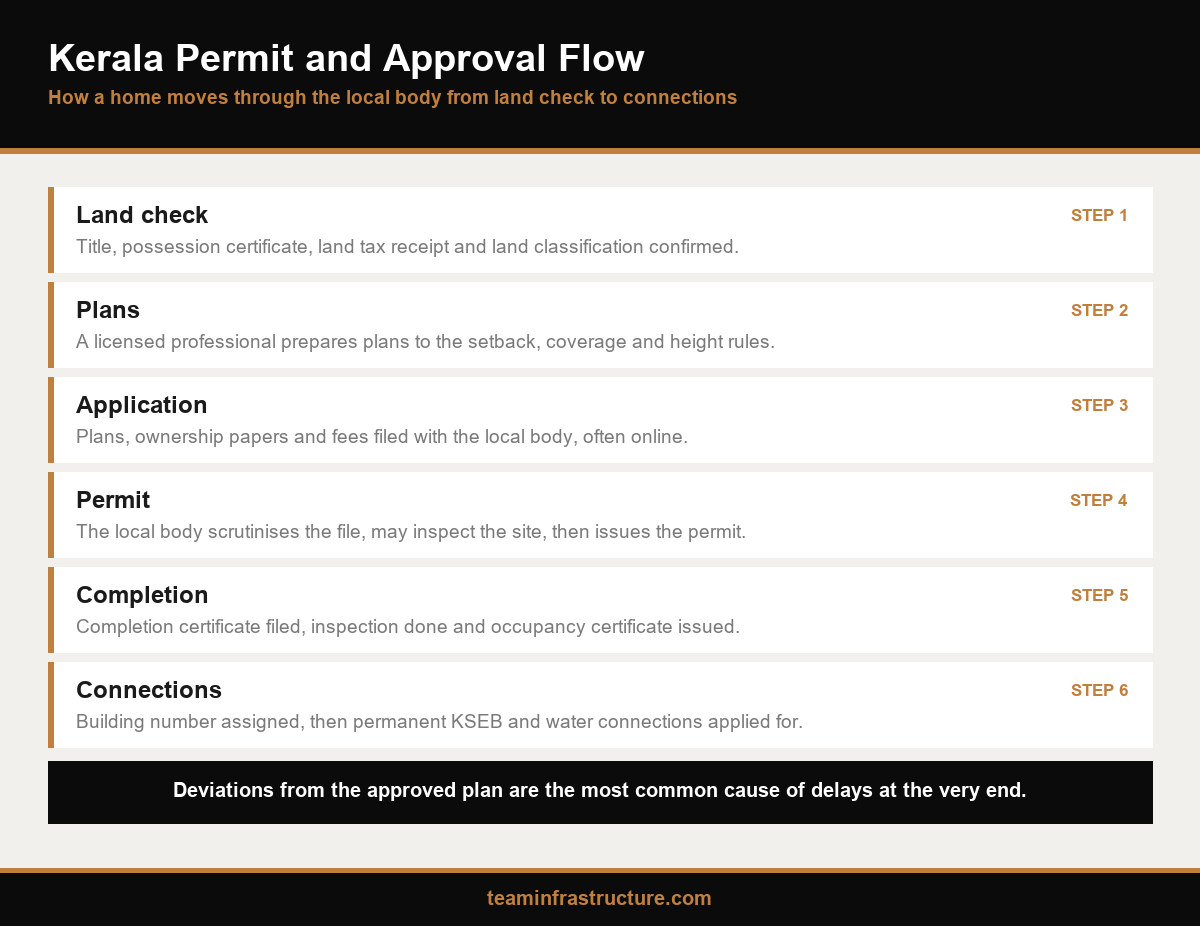
The flow is broadly the same everywhere. First, confirm the land: title deed, possession certificate, latest land tax receipt, and the land's classification, including whether it is recorded as paddy land or wetland, which restricts building. Second, a licensed architect, engineer or building designer prepares plans that meet the setback, coverage, floor area, height and parking rules for your plot. Third, the application is filed with the local body, increasingly online, with the plans, ownership documents and fees. Fourth, the local body scrutinises the file and may inspect the site before issuing the permit.
These statutory approvals Kerala local bodies grant also vary by building size and use. Some smaller homes may qualify for a simplified route under the rules, while larger or more complex buildings can need additional clearances from other departments. Your designer should confirm which category your home falls into before the drawings are finalised.
The permit carries a validity period, and deviations from the approved plan during construction can block the occupancy certificate later. If the design changes on site, ask whether a revised permit is needed before the work is done, not after. This is the most common way NRI projects get stuck at the very end.
Completion, Occupancy and Utility Connections
When the building is finished, the owner and the licensed professional submit a completion certificate with completion plans to the local body. The local body then inspects and, if the building matches the permit, issues the occupancy certificate. The building is then assessed for property tax and given a building number, which is often needed for permanent connections and later paperwork.
Electricity usually comes in two steps. A temporary connection for construction is applied for early, and a permanent domestic connection follows at the end. KSEB handles both, and the application asks for proof of ownership or occupancy and, for permanent supply, typically the building number. Ask your builder to plan the temporary connection before mobilisation so the site does not depend on generators.
A piped water connection from the Kerala Water Authority, where one is available, follows a similar pattern, with ownership documents and the building number. Many homes outside city limits rely on an open well or a bore well instead, so confirm early which applies to your plot.
These final approvals are where a well drafted power of attorney and an organised coordinator earn their keep. Allow roughly four to eight weeks from completion to permanent connections, indicatively, and longer if a deviation needs regularising. Our guide to the cost of building a house in Kerala places these fees in the overall budget.
Building a Document Vault That Survives Distance
Distance makes paperwork fragile. Papers sit in a cupboard in Kochi while the owner is in Muscat, and nobody is quite sure which version of the plan was approved. A shared document vault solves this.
Use a cloud folder with a fixed structure: land and title, permits and approved drawings, power of attorney and identity documents, contract and payment records, stage reports and test results, utility applications, and completion and occupancy. Give the coordinator upload access, and keep the original paper documents in one secure place with a written index.
Scan every document on the day it is received, name each file with the date first, and never overwrite a superseded drawing. Store the receipt for every fee paid to the local body, KSEB and the water authority.
The vault protects you long after handover. Resale, home loans, insurance and future extensions all need the permit, the occupancy certificate and the approved drawings. Our list of documents to demand before signing a build contract is a useful starting point for the contract folder.
Conclusion
Approvals for an NRI home in Kerala are manageable from abroad when three things are in place: a narrowly drafted power of attorney, a reliable local coordinator with a written brief, and a builder who handles permit drawings and documentation properly. Everything else is sequencing and record keeping.
Before you sign anything, have a lawyer review the power of attorney and ask your designer to confirm the permit category for your plot. To plan the design, permit and build sequence for your own plot, talk to our team in Tripunithura.
This article is general information, not legal advice. Processes and timelines are indicative for Kochi and Ernakulam district as of October 2026 and do not constitute a quotation.
Frequently Asked Questions
How do I get NRI property construction approval Kerala local bodies will accept while living abroad?

Can a power of attorney be used to apply for a building permit in Kerala?
Who issues building permits in Kerala?
Should my local coordinator be the same person as my builder?
What is the difference between a completion certificate and an occupancy certificate?
When should I apply for KSEB and water connections?