NRI Payment Milestones for Turnkey Construction in Kerala
 Renovation
NRI payment milestones Kerala families agree at the start of a build decide more than cash flow. They decide how much control you keep from Dubai, London or Singapore once the foundation is poured. Most disputes in overseas-owned projects do not start with bad work. They start with money that went out before the work it was meant to pay for.
A well designed schedule keeps every instalment one step behind the site, never ahead of it. This guide sets out how to structure stage payments on a turnkey home, what evidence should trigger each release, how to handle transfers from abroad, and how to keep a sensible amount back until handover. If you are planning a build in Kochi or Ernakulam, speak with the TeamInfra project team before you agree any advance.
Key Takeaways
- Tie every instalment to a finished, inspected stage, not to a calendar date or a phone call.
- Keep the advance modest and link it to clear mobilisation work such as setting out, site office and material store.
- Ask for an evidence pack before each release: dated photos, measurements, test results and an engineer's sign off.
- Plan the transfer route early, and keep a clear trail of every payment in Indian rupees for tax and audit purposes.
- Hold back a final retention amount until snags are closed and documents, warranties and as built drawings are handed over.
Why NRIs Need a Different Payment Structure
A resident owner can drive past the plot on a Sunday and see whether the slab is cast. An owner working abroad cannot. That single difference changes how a construction payment schedule should be written.
In a local build, payments are often loose: an advance, a few round sums when the builder asks, and a final settlement. That habit becomes risky at a distance. When you cannot see the site, the payment schedule becomes your main control. Each instalment is the moment you either confirm that work is right or stop and ask questions.
Turnkey contracts suit overseas owners for this reason. One firm carries design, approvals, materials, labour and handover, so there is one party to pay and one party accountable. A turnkey construction payment schedule also fits neatly around physical stages, because one team controls the sequence. Our guide to contract types and payment schedules explains how lump sum, item rate and cost plus contracts differ. For most NRI families building a home, a lump sum turnkey contract with stage payments is the simplest to monitor.
The Norka Roots portal run by the Government of Kerala is also worth bookmarking for wider support available to non resident Keralites.
A Practical Milestone Structure for a Turnkey Home
There is no single legal template, and every contract should be read with your own advisers. The structure below is indicative for a two storey turnkey home in Ernakulam district, and shows the logic rather than fixed percentages.
Advance and mobilisation. A modest amount on signing, released only once the drawings are approved, the site is cleared, the setting out is done and the site store is in place. Avoid large advances on signature alone.
Foundation and plinth. Released when footings, plinth beam, anti termite treatment and plinth filling are complete, with reinforcement photos taken before concreting.
Ground floor frame. Released when ground floor columns and the first roof slab are cast, with concrete cube results on record.
First floor frame and roof. Released when the upper floor and roof slab are complete and the roof has been checked for slope and drainage.
Masonry, lintels and services rough in. Released when walls are up, lintels are cast and electrical and plumbing lines are laid and pressure tested, before plastering covers them.
Plastering and waterproofing. Released after plastering, and after waterproofing in toilets, balconies and the terrace has passed a ponding test.
Flooring, joinery and fittings. Released when tiling, doors, windows and fittings are installed to the agreed specification.
Painting, final services and handover. Released at practical completion, less the retention described below.
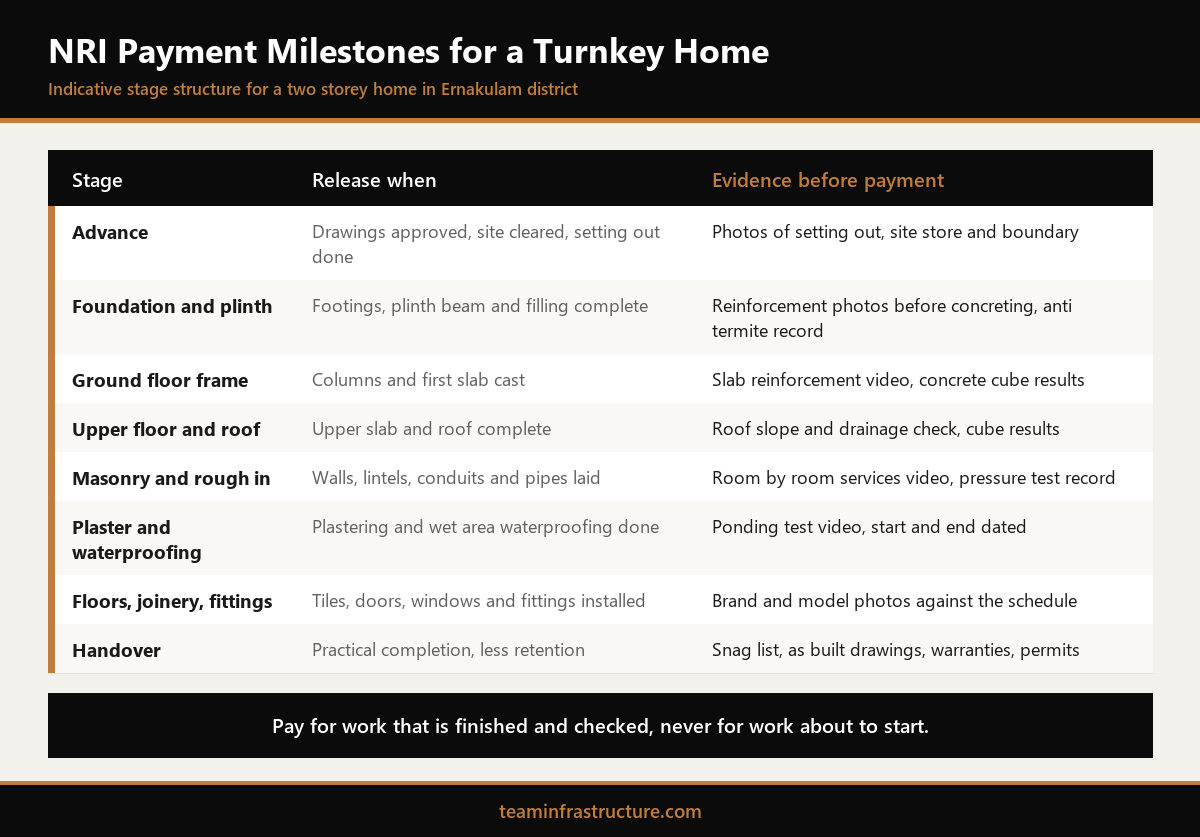
The principle behind every line is the same. Pay for what is complete and checked, not for what is about to start. Our article on documents to demand before you sign lists what should be attached to the contract alongside this schedule.
The Evidence Pack That Should Trigger Each Payment
A milestone without evidence is just a date. Agree in writing what you will receive before each release, and how many days the builder has to send it.
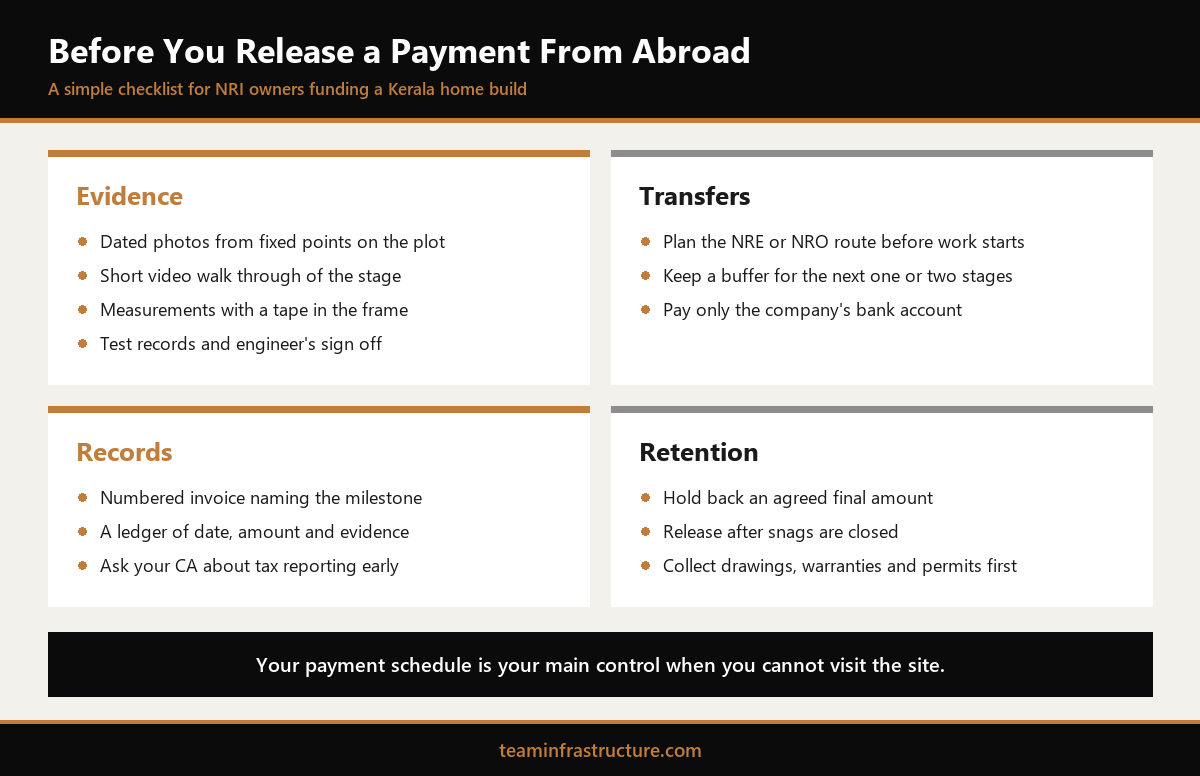
A useful evidence pack has four parts. First, dated photographs taken from fixed points on the plot, so you can compare stage to stage. Second, a short video walk through of the completed stage. Third, the key measurements against the approved drawings, with a tape or measuring staff visible in the frame. Fourth, any test records for that stage, such as concrete cube results, plumbing pressure tests or waterproofing ponding tests, with the engineer's sign off.
Three stages deserve extra care because the work disappears once the next stage begins: foundation reinforcement, slab reinforcement and waterproofing. Ask for these reports before concrete is poured or tiles are laid, never afterwards. The Bureau of Indian Standards publishes the codes your structural engineer should be working to, and asking which codes apply is a fair question at every structural stage.
If a pack arrives incomplete, hold the payment and ask for the missing items. A good builder will not be offended. Clear evidence protects them as much as you, because it ends arguments before they begin.
Transfers, Records and Tax Paperwork from Abroad
Payments for a home in Kerala are made in Indian rupees, and most overseas owners fund them through their NRE or NRO accounts. The Reserve Bank of India sets the rules for how non residents hold and use these accounts, and your bank can explain which account suits your situation.
Plan the route before work starts, not when the first invoice arrives. International transfers can take a few working days, and exchange rates move. Some families keep a buffer in an Indian account to cover the next one or two milestones, so a slow transfer never holds up the site.
Every payment should be made to the contracting company's bank account, against a numbered invoice that names the milestone. Avoid cash, avoid paying individual workers directly and avoid transfers to personal accounts. Keep a simple ledger with the invoice number, date, amount, milestone and the evidence pack that supported it. Ask your chartered accountant early about any tax deduction or reporting obligations that apply to contractor payments in your case, so nothing has to be corrected later.
If a relative in Kerala holds a power of attorney, decide exactly what they can approve. Many families let a relative visit the site and confirm progress, while keeping the final payment decision with the owner abroad.
Retention, Variations and the Final Payment
The last instalment is your strongest point of leverage, so do not release all of it at practical completion. A retention amount held until snags are closed is common practice and gives the builder a clear reason to finish the small items that matter in daily life: a sticking door, a weak tap, a missing switch plate.
Link the final release to a written handover list: the snag list signed off, as built electrical and plumbing drawings, warranties and manuals, meter readings, keys and copies of the building permit and occupancy papers. In Kerala, building permits and occupancy run through your local body, and many local bodies now process them through the K-SMART portal.
Variations need their own discipline. If you upgrade tiles or add a room during the build, that change should be priced and approved in writing before the work is done, and billed as a separate line. Mixing variations into milestone invoices is how budgets lose shape. Our breakdown of costs that rarely appear in a first quote shows where those surprises usually come from.
Conclusion
A clear payment structure is the most practical way to manage a home build from abroad. Pay against finished and inspected stages, demand an evidence pack every time, keep a clean record of every transfer and hold a retention until the handover list is complete.
TeamInfra's turnkey construction service is built around stage wise quality checks and regular project updates, which makes milestone payments easy to follow from any time zone. You can see completed homes on our projects page. To set up a payment schedule that fits your plot and your family's plans, talk to our team in Tripunithura.
Milestone structures and timings are indicative for Kochi and Ernakulam district as of October 2026. They are not legal, tax or financial advice, and they do not constitute a quotation.
Frequently Asked Questions
What are NRI payment milestones in Kerala home construction?

How much advance should an NRI pay to a builder in Kerala?
What evidence should I ask for before releasing a payment?
Can I pay my Kerala builder from an NRE or NRO account?
Should I keep a retention amount until handover?
Can a relative in Kerala approve payments for me?