The Hidden Costs Nobody Quotes in a Kerala House Build
 General
Most Kerala house budgets do not fail because the builder was expensive. They fail because the budget covered the building and the project needed more than a building. The hidden costs of house construction in Kerala are not secrets, they are simply outside the way the market quotes. This guide lists them, with typical amounts, so you can put them in the budget before they arrive in the invoice.
Key Takeaways
- On a Rs 40 lakh building, expect Rs 10 lakh to Rs 20 lakh of costs that sit outside the per square foot rate.
- The largest are interiors, external works and utility connections. None of them is optional if you intend to live in the house.
- Variation cost is the avoidable hidden cost. Decisions made late on site always cost more than the same decisions made early on paper.
The Statutory and Approval Layer
This layer is modest per item and easy to overlook entirely, because it arrives before any building work and therefore before most owners are thinking about money.
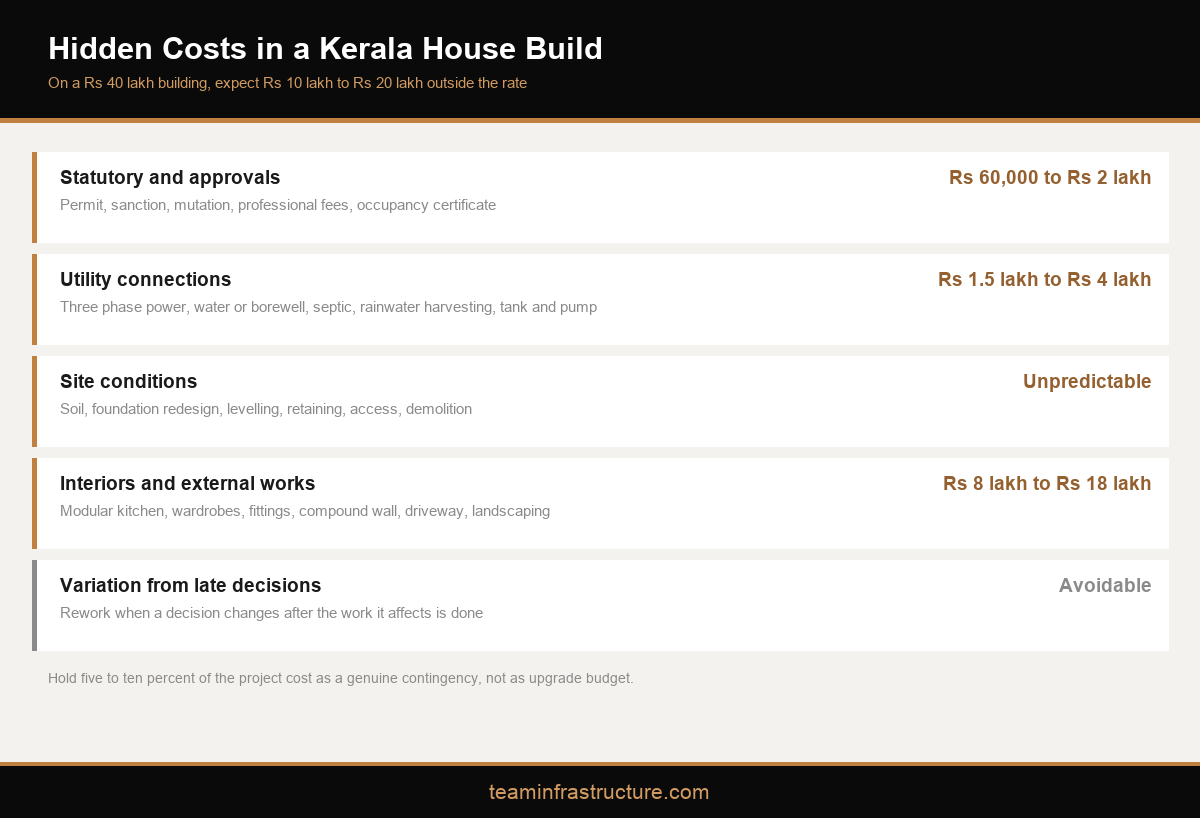
Building permit and plan sanction fees through your local self government body come first, and the amount varies with the built up area and the local body. Land tax mutation and related documentation follow. Then the occupancy certificate at the end of the project, which owners frequently forget and then need urgently for a loan disbursement or a utility connection. Professional fees for the architect and the structural engineer sit alongside these, and the structural design certification is not optional if you want a building anyone will insure or finance. Statutory frameworks for all of this sit within Indian building legislation available through the India Code repository, and the practical route is set locally.
Budget Rs 60,000 to Rs 2 lakh across this layer for a typical residential project, higher for larger homes.
The Utility Connection Layer
This is where owners are most often genuinely surprised, because these costs are payable to third parties and no builder can absorb them.
The three phase electrical connection and its security deposit come first, and the amount rises with the connected load you declare. The water connection follows, or a borewell or well if a piped connection is unavailable, and a borewell is entirely dependent on depth and yield, which is not knowable in advance. Then the septic system or sewerage connection. Then rainwater harvesting, which Kerala building rules require for many plot sizes and which is worth doing properly rather than minimally, since rainwater harvesting reduces running cost for the life of the house. Finally the overhead tank, pump and sump.
Budget Rs 1.5 lakh to Rs 4 lakh here, and treat the borewell as a genuine unknown rather than a line item. Ask neighbours on adjoining plots what depth they had to reach, since that is the best available indicator and it costs nothing to find out.
One timing trap is worth naming. The electrical connection is frequently applied for late, because it feels like a finishing task, and the sanction can take longer than expected. A house that is otherwise complete but waiting on a connection is an expensive thing to own, so start that application well before the plastering is finished rather than after the painting.
The Site Condition Layer
These costs are invisible in a quotation because they cannot be known until someone investigates the ground, and they are the largest single source of overrun in Kerala.
Soil investigation itself is cheap and almost always worth it. What it reveals may not be. Filled ground, soft clay or a high water table can require a deeper or piled foundation, and that decision alone can move a project by lakhs. Plot level differences may need retaining walls or fill, and fill is charged by volume, which grows quickly. Narrow site access means material is handled manually rather than delivered to the point of use, and that lands squarely in the labour line. Tree removal, existing structure demolition and boundary disputes all sit here too.
Soil behaviour in Kerala varies sharply over short distances, since laterite ground, coastal sand and paddy fill each demand different foundations. Anyone quoting a foundation cost before seeing a soil report is guessing, and our note on what makes a construction company reliable in Kerala explains why a firm that insists on investigation first is protecting you rather than delaying you.
The Finishing and Interiors Layer
This is the largest hidden cost by value, and the one most often deferred until the money has gone.
Modular kitchen and wardrobes lead, at Rs 3 lakh to Rs 15 lakh depending on size and specification. Loose furniture follows, then light fittings, which are frequently excluded from the electrical scope even though the points are included. Then curtains and blinds. Then the compound wall, gate and driveway, which on a normal plot commonly runs to several lakh. Then landscaping and external lighting. Then the water purifier, geysers, fans and any appliance you assumed was covered.
On a Rs 40 lakh building, this layer alone commonly totals Rs 8 lakh to Rs 18 lakh. Our guide to affordable interior design packages in Kerala sets out what each specification tier includes so the number stops being a surprise.
Two items in this layer are worth calling out because they are so consistently assumed to be included. Light fittings are the first. Most electrical quotations cover the points, the conduit and the wiring, and stop at the fitting itself. On a full house the fittings alone can run to a meaningful sum, and the assumption is only discovered when the electrician asks which lights to install. The second is the compound wall, which is priced by length and height rather than by house size, so it lands proportionally heavier on smaller homes and is almost never in the building rate.
The contingency you should actually hold
A contingency of five to ten percent of the project cost is sensible, weighted towards the upper end if the soil report shows difficulty, if the plot needs significant levelling or retaining work, or if you are building remotely and cannot resolve site queries the same day. Hold it as a genuine reserve rather than as budget you intend to spend on upgrades, because its purpose is to absorb the borewell that goes deeper than expected and the foundation that needs redesigning.
The Avoidable One: Variation Cost
Every layer above is unavoidable. This one is not, and it is often the largest.
Variation cost is what you pay when a decision changes after the work it affects is done. Moving a socket after plastering means breaking a wall, rewiring, replastering and repainting. Changing a bathroom layout after plumbing is cast means breaking a floor. Adding a false ceiling after wiring is complete means opening it again. In each case the material cost is small and the rework cost is not.
The fix is sequencing rather than discipline. Freeze the plan, the specification and the finish selections before construction starts, then let the site follow drawings rather than conversations. This is the single strongest argument for engaging design and construction under one accountability line, as set out in why design build saves time in Kochi, and it is why virtual reality assisted design review matters for owners building from outside Kerala who cannot settle decisions by standing on site.
Conclusion
The hidden costs of house construction in Kerala are predictable once listed: approvals, utility connections, site conditions, interiors and external works, plus whatever variation your sequencing allows. On a Rs 40 lakh building, budget Rs 10 lakh to Rs 20 lakh for all of it, commission a soil report before anyone prices a foundation, and settle your finishes before the electrical work begins. Do those three things and the only surprise left is the borewell. For a project budget that includes every layer, talk to our team in Tripunithura.
Figures are indicative market ranges for Ernakulam district as of August 2026 and are not a quotation.
Frequently Asked Questions
What are the biggest hidden costs when building a house in Kerala?

How much should I add to a builder's quotation for a realistic budget?
Are approval fees really significant?
Why can nobody quote my foundation cost upfront?
Is a borewell cost predictable?
Are light fittings included in the electrical scope?
What does a compound wall typically cost?
How do I avoid variation costs?
Should I keep a contingency and how much?
What should I check before releasing the final payment?