10 Documents to Demand Before You Sign a Build Contract
 General
Verification beats reputation. A firm's reputation is what other people say; a document is a fact you can check yourself. On the largest purchase most Kerala families make, that distinction is worth an afternoon.
None of the ten below is unusual to ask for. A legitimate construction company produces all of them without difficulty, and the ones that hesitate have told you something more useful than any testimonial.
Key Takeaways
- All ten documents are ordinary for a legitimate firm and checkable in a day.
- Two of them, the GST registration and the professional credentials, you can verify independently rather than taking on trust.
- The exclusions list is the most informative page in any quotation.
- Payment to a personal account on a company contract is a warning sign in itself.
- Ask for one completed project reference from over two years ago. That is when workmanship shows.
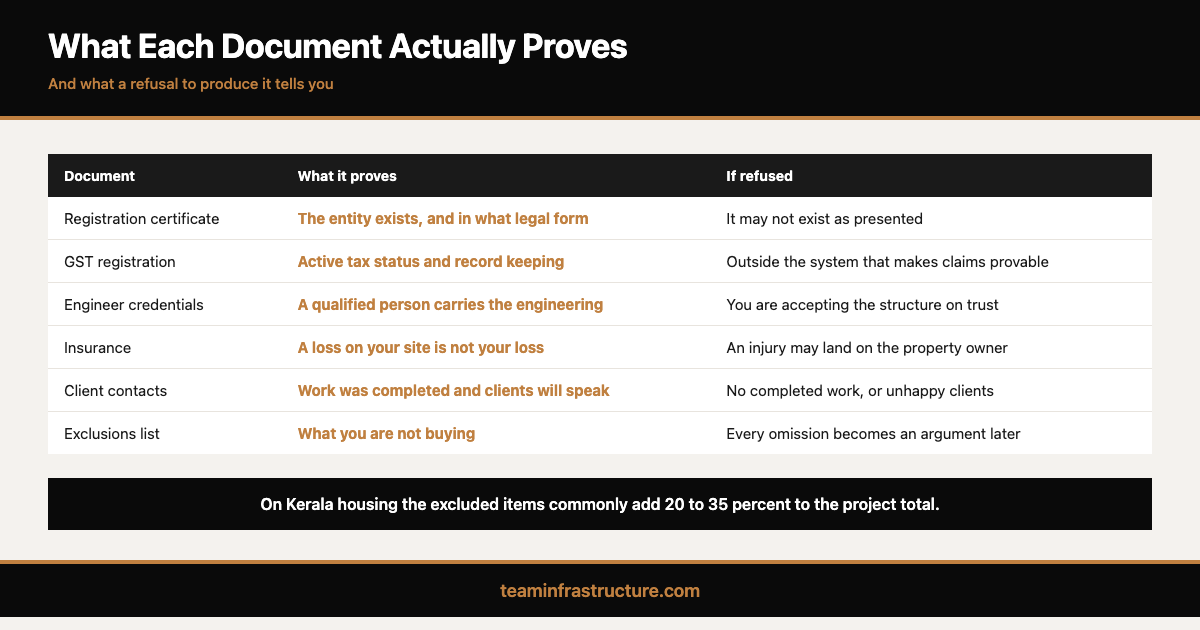
1. Certificate of Incorporation or Registration
What it proves: that the entity exists, and in what legal form. A proprietorship, a partnership, a limited liability partnership and a private limited company carry different levels of liability and different degrees of permanence.
Why it matters: you need to know who you are actually contracting with. If the firm is a trading name used by an individual, then the individual is your counterparty and the company branding is decoration.
A refusal means: the entity may not exist as presented.
2. GST Registration
What it proves: active tax registration, which requires the business to file returns and maintain records.
Verify it yourself. Do not accept a certificate image. Enter the GST number on the GST portal and confirm the name matches and the registration is active. This takes a minute and it is the single cheapest verification available.
Why it matters: a firm outside the tax system is also outside the record keeping that makes any later claim provable. It is also the firm most likely to offer a cash discount, which is discussed below.
3. Professional Credentials of the Technical Staff
What it proves: that a qualified person is responsible for the engineering.
Ask who the qualified engineer on your project will be, and for their qualification. On any Kerala house the structural design must be certified by a qualified engineer, and where an architect is engaged they should be registered with the Council of Architecture.
Why it matters: the structural design is the part of your house that cannot be inspected or corrected later. A firm that cannot name the person signing it is asking you to accept the most important element on trust.
4. Insurance
What it proves: that a loss on your site does not become your loss.
Ask for contractor all risks cover and public liability cover, both in date and with a sum insured appropriate to your project value. Ask separately about workmen's compensation cover for the labour on site.
Why it matters: an injury on your site, or damage to a neighbouring property caused by the works, can land on the property owner where the contractor is uninsured. This is the document most often absent among smaller firms and the one whose absence is most expensive.
5. Prior Client Contacts
What it proves: the firm has completed work and its clients will speak about it.
Ask for two or three telephone numbers rather than written testimonials, and specifically ask for at least one project completed more than two years ago. Recent handovers all look excellent. Two years in is when curing discipline, waterproofing detail and material quality begin to show.
Ask those clients four questions. Did the final cost match the contract. Was the programme met. What happened when something went wrong. Would you use them again.
A refusal means: either there are no completed projects, or the clients would not be complimentary.
6. A Sample Working Drawing and Specification Set
What it proves: how the firm actually works.
Ask to see a complete drawing and specification set from a finished project, not portfolio photographs. Look for whether the wet areas are detailed, whether the electrical layout shows switch positions rather than just light points, and whether materials are specified against standards rather than by brand alone. The relevant material and workmanship standards are published by the Bureau of Indian Standards.
Why it matters: every question the drawings fail to answer is answered on site by a mason. A thin drawing set is not a saving, it is a transfer of decisions from a designer to whoever is holding the trowel. Our guide to what you actually receive at each design stage sets out what a complete set contains.
7. The Written Exclusions List
What it proves: what you are not buying.
This is the most informative page in any quotation and the one most often absent. On Kerala residential work the items commonly outside the building rate are approvals and statutory fees, the compound wall and gate, utility connections and deposits, the septic system, rainwater harvesting, landscaping and driveway, and interiors.
Why it matters: homeowners read a building rate as a project cost. The gap between the two is routinely 20 to 35 percent, and it is not the builder being evasive, it is simply how the market quotes. Our guide to the hidden costs nobody quotes covers each of them.
8. The Structural Basis of the Quotation
What it proves: that the price is built on a defined engineering standard rather than an assumption.
Ask for the concrete grade, the steel grade, the specified cover to reinforcement, the assumed curing period and the name of the certifying engineer. Also ask whether the price assumes a foundation type, and if so, on what basis. A quotation that assumes a shallow foundation without a soil investigation is a quotation with a variation built into it. Our guide to soil testing and foundation types explains what should be established first.
9. A Sample Contract
What it proves: what the firm's standard terms actually say, read at a point when you are not yet committed.
Look for the payment schedule and whether it is tied to verified site stages or to dates; the retention amount and the defect liability period; the variation procedure and who authorises changes; the completion date and what follows if it is missed; and the termination provisions.
Our guide to construction contract types and payment schedules covers what each structure means for your risk.
10. Bank Details in the Company Name
What it proves: that the money goes to the entity you contracted with.
Why it matters: payment to an individual's personal account under a company contract undermines every other document on this list. It also frequently accompanies the offer of a cash discount, which is worth naming plainly: a cash discount means no record, and no record means no recourse. The discount is small and the exposure is the entire contract value.
The Documents You Should Receive Later
Verification does not end at signature. Four further documents arrive during and after the works, and they are worth naming in the contract now so they are not negotiated at handover when your leverage has gone.
The approved permit and its drawings, issued by the local body, which should be kept with the property records permanently.
Photographic records of the covered work, meaning the foundation excavation and reinforcement, every slab and beam reinforcement layout before pouring, and the waterproofing before tiling. These are the elements nobody can inspect after the fact, and a fortnightly photographic record costs nothing and settles most later arguments about what was actually built.
Test certificates and material records for cement and steel, so the material actually delivered can be tied to a source.
The handover package, comprising as built drawings, the structural certificate, electrical test certification, warranties, the finish and material schedule, the closed snag list and the occupancy certificate.
Write these into the contract as deliverables rather than assuming them. A firm that agrees to provide a photographic record of covered work is a firm content to have that work looked at, which is itself the reassurance you were seeking with the other ten documents.
What to Do With the Answers
Verification is not adversarial and should not feel it. A serious firm expects these questions and has the answers ready, because it deals with informed clients regularly. The reaction to the request is itself the most useful signal in the process.
Where a document genuinely does not apply, for instance a small proprietorship without certain registrations, that is not automatically disqualifying. What matters is that the firm says so plainly rather than deflecting, and that you understand what protection you are giving up.
Once satisfied, keep every document with the contract. If a dispute arises two years later, the file you assembled in one afternoon before signing is what determines how it goes. Our wider guide to verifying a builder before you sign sets the verification in context, and our guide to the red flags that precede trouble covers the warning signs to watch during the work itself.
Conclusion
Ten documents, one afternoon, and two of them verifiable independently. Against a contract worth tens of lakhs and a house you intend to live in for decades, it is the cheapest risk reduction available to a homeowner in Kerala.
Ask for all ten. Verify the GST number yourself. Telephone a client from more than two years ago. Read the exclusions list twice. And insist the money goes to the company account. To discuss a project on that basis, talk to our team in Tripunithura.
Frequently Asked Questions
What documents should I ask a builder for in Kerala?

How do I verify a builder's GST number?
Is a contractor without GST registration a problem?
Why ask for a project completed two years ago?
What insurance should a builder carry?
Should I accept a cash discount?
What is an exclusions list?
Who signs the structural design?
Can I use these checks for a renovation contractor too?
What if the builder refuses to provide something?