Construction Cost Per Sq Ft in Kerala: 2026 Pricing Guide
 General
The construction cost per square foot in Kerala is the number every homeowner asks for first and the number most quotations answer least clearly. One firm says Rs 1,900. Another says Rs 2,700. Both are describing real buildings. This guide explains what sits inside each rate in 2026, what sits outside it, and how to compare two quotations without being misled.
Key Takeaways
- Kerala rates in 2026 fall into three bands: roughly Rs 1,800 to Rs 2,200 economy, Rs 2,200 to Rs 2,800 standard, and Rs 2,800 to Rs 3,500 or above premium.
- The rate covers structure and basic finishes. Approvals, compound wall, utility connections and interiors are almost always outside it.
- Rates are quoted on plinth area, not carpet area. Comparing one against the other makes the cheaper quotation look dearer.
What the Three Rate Bands Actually Buy
A rate is a specification in disguise. The difference between Rs 1,900 and Rs 2,900 is not profit margin, it is the tile you walk on, the joinery you open, the number of light points in a room and the paint system on the wall. Reading the bands as specifications rather than prices makes quotations far easier to judge.
| Band | Rate per sq ft | Structure | Flooring | Joinery | Electrical |
|---|---|---|---|---|---|
| Economy | Rs 1,800 to Rs 2,200 | Standard RCC frame, solid or hollow block walls | Vitrified tile, basic range | Flush doors, standard windows | Basic point count, surface fittings |
| Standard | Rs 2,200 to Rs 2,800 | Same frame, better waterproofing and finishes | Better tile selection, granite in kitchen | Some designed joinery, better hardware | Higher point count, planned lighting |
| Premium | Rs 2,800 to Rs 3,500 and above | Designed structure, full waterproofing system | Large format or natural stone | Custom joinery throughout | Full lighting design, automation provisions |
Notice that the structure line barely changes across the three bands. That is deliberate. Structural adequacy is not a grade you buy up into, it is a baseline set by Bureau of Indian Standards guidelines and it should be identical in an economy home and a premium one. What changes is everything you can see and touch.
This matters when a builder offers to move you up a band. The upgrade is worth having if it buys better flooring, joinery and fittings, which are the things you interact with daily. It is not worth paying for if it is presented as buying a stronger building, because a properly built economy home and a properly built premium home have the same frame, the same concrete grade and the same waterproofing. If a quotation implies otherwise, the economy option was under specified rather than the premium option being superior.
How to Compare Two Quotations Properly
Most homeowners compare the bottom line, which is the one number that cannot be compared. A meaningful comparison needs five things stated in writing on both quotations, and a firm that hesitates over any of them has told you something useful.
First, the finish specification, item by item: tile make and size, sanitaryware range, joinery material, paint system, electrical point count. Second, the measured area statement and whether it is plinth or carpet, with the car porch and balcony factors stated. Third, the structural basis, meaning concrete grade, steel grade, cover and assumed curing period, plus the name of the chartered engineer certifying the design. Fourth, a written exclusions list. Fifth, the payment milestone schedule tied to site stages rather than dates.
With those five in hand, two quotations that looked Rs 8 lakh apart usually turn out to be Rs 1 lakh apart on identical scope, with the balance explained by different assumptions. Occasionally the gap survives, and then you have learned something real rather than guessed at it. Our guide to what makes a construction company reliable in Kerala covers the documents worth demanding alongside the price.
Plinth Area, Carpet Area and Why the Confusion Costs You
Kerala quotations are almost always priced on plinth area, meaning the built up footprint measured to the outer face of walls, with car porch and balconies usually included at a reduced factor. Carpet area, the floor you can actually furnish, runs roughly 20 to 25 percent smaller. The gap is large enough to invert a comparison.
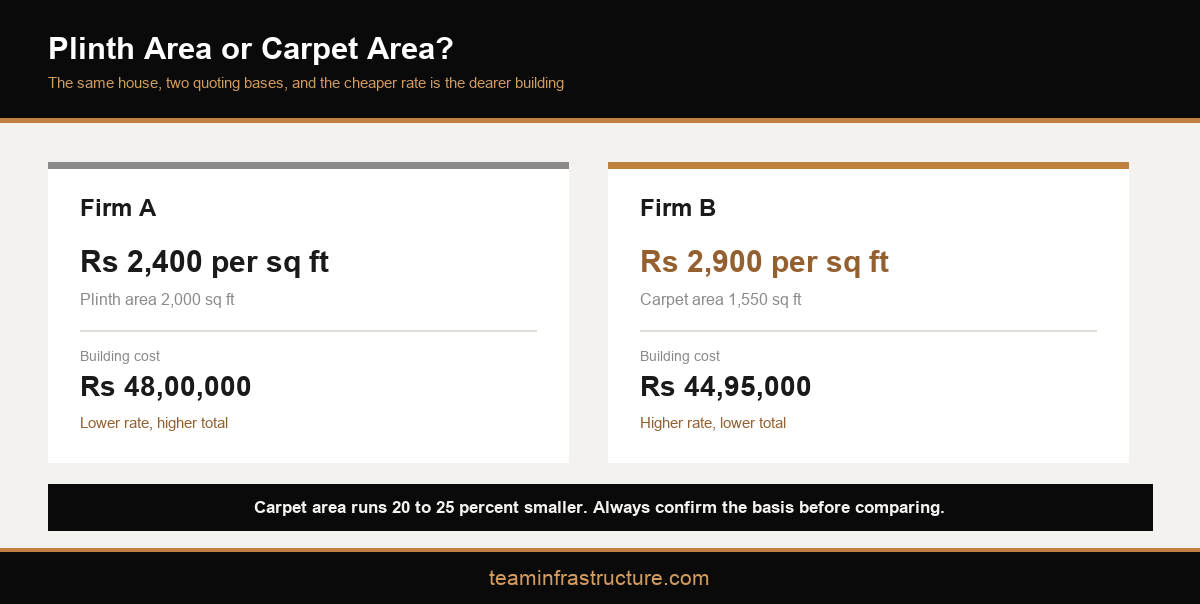
Take a 2,000 square foot plinth area home. At Rs 2,400 per square foot on plinth area the building cost is Rs 48 lakh. If a second firm quotes Rs 2,900 but measures on carpet area of about 1,550 square feet, its cost is roughly Rs 45 lakh. The higher rate is the cheaper building. Always ask which basis applies before you compare anything, and ask for the measured area statement in writing. Our note on choosing a building contractor in Kochi covers the other places where quotations quietly differ.
What the Rate Does Not Include
This is where budgets break. The per square foot rate is a building rate, not a project rate, and six categories usually sit outside it.
Approvals and statutory fees come first, including the building permit from your local self government body and later the occupancy certificate. Then utility connections, meaning the three phase electrical connection and deposit, water connection, and a borewell or well if required. Then the septic system or sewerage connection. Then rainwater harvesting, which Kerala building rules require for many plot sizes. Then the compound wall, gate and driveway, which on a normal residential plot commonly runs to several lakh on its own. Finally interiors, meaning modular kitchen, wardrobes and loose furniture, frequently 15 to 25 percent of the building cost.
None of this is a builder being evasive. It is simply how the market quotes. The problem is only that homeowners read the building rate as the project cost. Our broader piece on what a full service construction company delivers from blueprint to handover sets out the whole scope so nothing arrives as a surprise.
Why Rates Vary Across Ernakulam
Two identical plans on two plots ten kilometres apart can price differently, and the reasons are physical rather than commercial.
Soil condition is the largest single variable and the only one that cannot be assessed by looking. A firm site takes a shallow foundation while soft or filled ground may need a deeper or piled solution, and that decision alone can move the total by lakhs. Laterite ground behaves very differently from coastal sand or paddy fill. Site access matters next, because a narrow approach means material is handled manually rather than delivered to the point of use, and that lands in the labour line. Plot level and retaining requirements follow. Finally, plan efficiency: a compact rectangle costs less per square foot than a plan with many corners, because corners consume material, labour and time. This is one reason layout planning pays for itself before a single block is laid.
None of these four variables is negotiable with a builder, because none of them is a commercial decision. They are physical facts about your plot. What is negotiable is whether they are established before the price or discovered after it. A firm that walks the site, checks access width, notes the level difference and asks for a soil report before quoting is not being slow. It is declining to give you a number it would later have to revise.
The rate is a starting point, not a contract
One further caution. A per square foot rate is a planning device. The contract should be built on measured quantities or a defined lump sum scope, not on the rate itself, because a rate applied to an area that later changes creates an argument rather than a price. Use the rate to decide whether the project is feasible, then move to a specification and a scope as soon as the plan is settled.
Conclusion
The construction cost per square foot in Kerala is a useful planning tool and a poor decision tool. Use the bands in this guide to set a realistic budget, then insist that every quotation you receive states its finish specification, its area basis and its exclusions in writing. Priced that way, two quotations become genuinely comparable and the cheapest number stops being the most expensive mistake. For a specification led estimate on your own plot, speak to our team in Tripunithura.
Rates are indicative market ranges for Ernakulam district as of August 2026 and do not constitute a quotation.
Frequently Asked Questions
What is the average construction cost per square foot in Kerala in 2026?

Does the rate include the compound wall?
Is the rate quoted on plinth area or carpet area?
Why is one builder Rs 700 per square foot cheaper than another?
How much extra should I budget for interiors?
Do rates change with the number of floors?
Does the monsoon affect construction cost?
Are published cost calculators reliable for Kerala?
What documents should the quotation include?
Can I reduce the rate without reducing quality?