Construction Contract Types and Payment Schedules in Kerala
 General
The contract is the only part of a house you can change for free. Once construction begins, every other decision costs money to revise, but the terms you agree beforehand cost nothing except the attention to read them.
Most Kerala homeowners give that document less attention than they give the tile selection. This guide covers the three contract types in use, what each does with risk, the payment schedule that protects you, and the five clauses worth insisting on.
Key Takeaways
- Three contract types are in general use, and each allocates price risk differently.
- Tie payments to verified site stages, never to calendar dates. This is the single most important term.
- Hold a retention of around five percent through a defect liability period.
- A written variation procedure prevents the most common form of cost escalation.
- A completion date with no stated consequence is an aspiration rather than a commitment.
The Three Contract Types
Item rate contract. Work is measured and paid at agreed rates per unit. The rates are fixed; the quantities are measured as built. Transparent and fair, adjusts naturally when scope changes, and requires that somebody measures. It suits clients who want to see exactly what they are paying for and are prepared to engage with the detail. A quotation built on a bill of quantities is the natural form.
Lump sum contract. A fixed price for a defined scope. Simple, gives budget certainty, and places the quantity risk on the builder, who prices for it. The critical requirement is that the scope is genuinely defined, meaning complete drawings and a full specification. A lump sum against vague drawings is not certainty, it is a dispute with a number on it.
Cost plus contract. Actual cost plus an agreed margin, with open records. Appropriate where scope genuinely cannot be defined in advance, which on residential work usually means unusual renovation or restoration. It requires trust and it requires the client to engage with the accounts.
| Type | Price risk | Suits | Watch for |
|---|---|---|---|
| Item rate | Shared | Clients wanting transparency | Quantities growing unnoticed |
| Lump sum | Builder | Clients wanting certainty, frozen design | Thin specification, variation pricing |
| Cost plus | Client | Undefinable scope, restoration | Cost control discipline |
For most Kerala house builds with completed drawings, either item rate or lump sum is appropriate. Our guide to verifying a builder before you sign covers verifying the firm you are contracting with.
The Payment Schedule
The single most important term in the document, and the one most often written loosely.
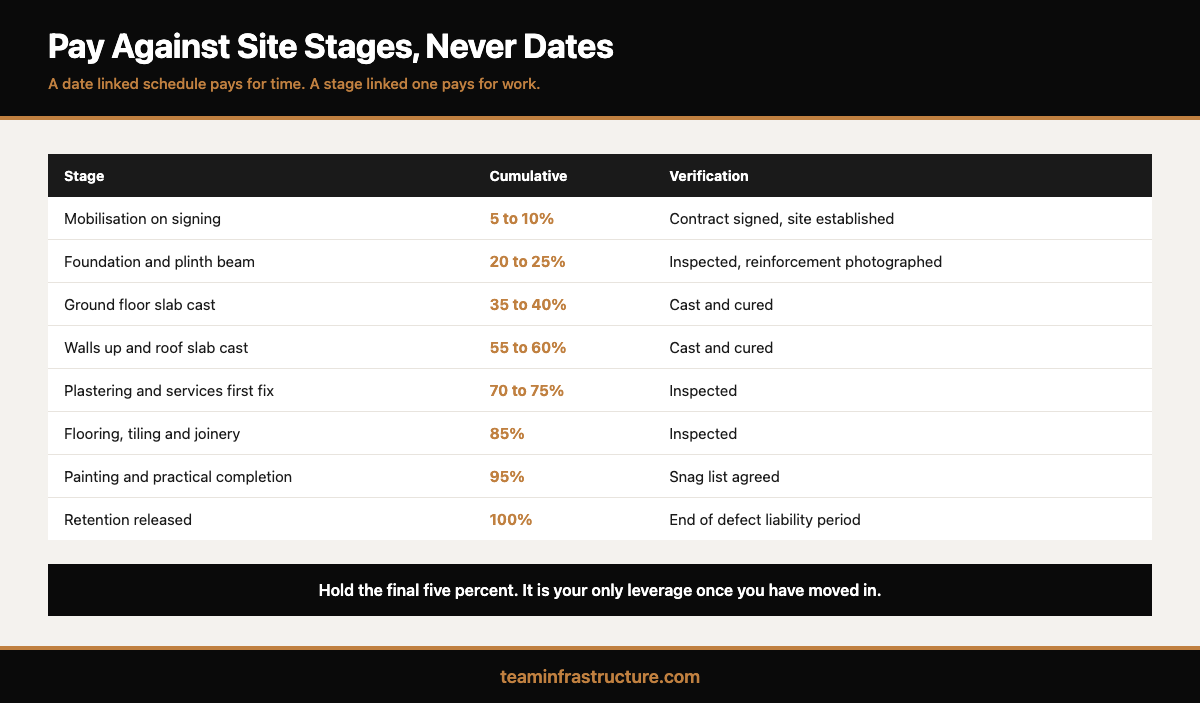
The principle is simple: payment follows verified site progress, not the calendar. A date linked schedule pays for time elapsed, which means that if the programme slips you have paid for work you do not have and lost your leverage to get it.
A typical stage linked schedule for a Kerala house looks like this.
| Stage | Cumulative percent | Verification |
|---|---|---|
| Mobilisation on signing | 5 to 10 | Contract signed, site established |
| Foundation and plinth beam complete | 20 to 25 | Inspected, reinforcement photographed |
| Ground floor slab cast | 35 to 40 | Cast and cured |
| Walls up and roof slab cast | 55 to 60 | Cast and cured |
| Plastering complete, services first fix | 70 to 75 | Inspected |
| Flooring, tiling and joinery complete | 85 | Inspected |
| Painting, second fix, practical completion | 95 | Snag list agreed |
| Retention released | 100 | End of defect liability period |
Three points about that table. The mobilisation payment should be modest; a large advance before work begins is a warning sign. Each stage should be verified before payment, not merely reported. And the final five percent should genuinely be held, because it is your only practical leverage once you have moved in.
The Five Clauses to Insist On
1. A defined scope and specification, attached. The contract should incorporate the drawings and the specification by reference, with drawing numbers and revision letters listed. A contract that says "as per plan" without identifying which plan has defined nothing.
2. A written exclusions list. What the price does not cover. On Kerala residential work this commonly includes approvals and statutory fees, compound wall, utility connections, septic system, rainwater harvesting and interiors, together 20 to 35 percent of the project. Our guide to the hidden costs nobody quotes covers them.
3. A variation procedure. No work outside scope proceeds without written authorisation, and the authorisation states the cost before the work happens. This single clause prevents the most common escalation pattern in residential construction, which is work carried out quietly and priced afterwards when there is no alternative but to accept it.
4. Retention and defect liability. Around five percent held for a defined period after handover, typically six to twelve months, covering defects that appear under use. Specify how a defect is reported and how long the builder has to attend.
5. Completion date and consequence. A date on its own is an aspiration. Attach a consequence, whether liquidated damages or another agreed mechanism, and also define what legitimately extends the date, which normally includes client instructed variations, approval delays outside the builder's control and exceptional weather.
Things Worth Adding
Material specification by standard. Reference the codes published by the Bureau of Indian Standards rather than brands alone, so substitutions can be judged on equivalence.
A price validity and escalation mechanism. Cement and steel move over a year long project. Establish who carries that and what triggers an adjustment, rather than discovering it in month eight.
A documentation schedule. As built drawings, test certificates, warranties, the finish schedule and the occupancy certificate, listed as deliverables rather than assumed.
A photographic record of covered work. Foundation reinforcement, every slab before pouring, and waterproofing before tiling. Cheap to require and decisive in any later dispute.
Insurance obligations. Contractor all risks, public liability and workmen's compensation, with evidence of currency required before work starts.
Termination provisions. Nobody expects to use them and they matter enormously if the relationship fails. Establish what happens to money paid, materials on site and drawings.
Payment Practice
Pay to the company account named in the contract, never to an individual. Take a receipt or invoice for every payment. Decline cash arrangements, because the small discount is bought with the loss of any record and therefore any recourse.
Keep a running statement showing the contract sum, variations approved, amounts paid and the balance. A homeowner who cannot state their current contract total has lost control of the project, and the moment of discovery is generally the final invoice. Our guide to the documents to demand before signing covers what to verify beforehand.
Labour Only and Material Supply Arrangements
A fourth arrangement is common in Kerala and sits outside the three types above: the homeowner buys materials and the builder supplies labour and supervision, priced per square foot or per unit of work.
The attraction is control over material quality and the removal of the builder's margin on materials. The reality is that the homeowner takes on a procurement job: ordering the right quantities at the right time, arranging storage and security on site, dealing with damaged or short deliveries, and absorbing the cost of anything ordered wrongly.
It works for clients who have time, storage, local market knowledge and the ability to visit the site often. It works poorly for anyone building remotely or working full time, and the savings are frequently consumed by wastage, emergency retail purchases and programme delay while a material is awaited.
If you do adopt it, three things need writing down. Precisely which materials the homeowner supplies and which the builder does, because the boundary items such as binding wire, consumables and scaffolding are where disputes start. What happens when the site stops because a material has not arrived, and who bears that cost. And what wastage allowance is assumed, so that a shortfall is not automatically a dispute.
Before You Sign
Four practical steps in the last week before signature.
Read the whole document once without the builder present, and mark every sentence you do not understand. Ambiguity you noticed and accepted is a choice; ambiguity you did not notice is a risk.
Check that the drawings and specification listed are the current revisions, by number and date. This is the most common administrative error and it undermines everything else.
Have someone qualified read it if the sum is significant. Against a contract worth tens of lakhs, a professional review is a rounding error.
Then sign both copies, initial every attached drawing and schedule, and keep your set with the approved permit and the verification documents you gathered. That file is what determines how any later disagreement goes.
Renovation Contracts Are Different
Renovation carries genuine uncertainty about what is behind the surfaces, so the contract has to accommodate discovery.
A lump sum against an unopened building transfers a risk the builder cannot price, so either the price carries a large contingency or the variations begin immediately. The better structures are an item rate contract, or a lump sum for defined work with a stated provisional allowance for the unknown elements, drawn down against measured work.
The contract should also state the assumptions explicitly: that the roof timbers are sound, that existing drainage is serviceable, that no structural repair beyond what was visible is required. Naming those turns a nasty surprise into an anticipated one. Our guide to renovating an existing home covers the wider process.
Conclusion
Read the contract before you are emotionally committed to the builder. Tie payments to verified stages. Hold the retention. Require written authorisation for every variation with the price stated first. Attach the drawings by number. And put a consequence next to the completion date.
None of that costs anything, and together it converts a house build from a matter of trust into a matter of agreement. To discuss a project on those terms, talk to our team in Tripunithura.
This guide is general information about contracting practice and not legal advice. Contract terms should be reviewed by a qualified professional for your specific project.
Frequently Asked Questions
Which contract type is best for a Kerala house?

How should payments be structured?
How much advance is reasonable?
What is retention and how long is it held?
How should variations be handled?
What if the builder finishes late?
Should I sign a lump sum for a renovation?
Can I pay in cash for a discount?
Who should hold the drawings referenced in the contract?
What documents should the contract require at handover?