Civil Contractors in Kochi: Scope, Rates and Selection
 General
Civil contractor is one of the loosest terms in Kerala construction. It covers an individual with a crew, a registered firm with employed engineers, and everything in between, and the difference matters enormously to a client because the three carry different capabilities and different recourse.
This guide sets out what the role actually covers, what the work costs in Kochi, how to tell the categories apart, and how to select one.
Key Takeaways
- Civil contracting covers the structural and building work: substructure, frame, masonry, plastering and associated site work.
- In Kochi civil work runs roughly Rs 1,100 to Rs 1,900 per square foot as a structure and shell scope in 2026.
- The single most useful distinction is whether you are engaging an individual or a registered entity.
- Whoever you engage, the structural design must be certified by a qualified engineer.
- Being present at four site moments matters more than anything in the contract.
What Civil Contracting Covers
The civil scope is the building itself, before finishes and services take over.
Site clearance, setting out and excavation. Foundation work, whether footings, raft or piling, following the soil investigation. The plinth and backfilling. The structural frame, meaning columns, beams and slabs in reinforced concrete. Masonry and blockwork. Lintels and sills. Roof structure and slab. Internal and external plastering. Waterproofing to terraces and wet areas. Drainage, septic arrangement and external works. And the site management that holds all of it together.
What sits outside civil scope in most Kochi arrangements: electrical and plumbing beyond conduit and sleeve provision, flooring and tiling in some contracts, joinery, painting, and interiors. Establish the boundary in writing, because the items at the edges are where scope disputes begin.
What It Costs in Kochi
Indicative market ranges for Kochi and Ernakulam district as of August 2026.
| Scope | Rate per sq ft |
|---|---|
| Civil structure and shell, economy specification | Rs 1,100 to Rs 1,400 |
| Civil structure and shell, standard specification | Rs 1,400 to Rs 1,700 |
| Civil structure and shell, higher specification | Rs 1,700 to Rs 1,900 and above |
| Full construction including finishes | Rs 1,800 to Rs 3,500 |
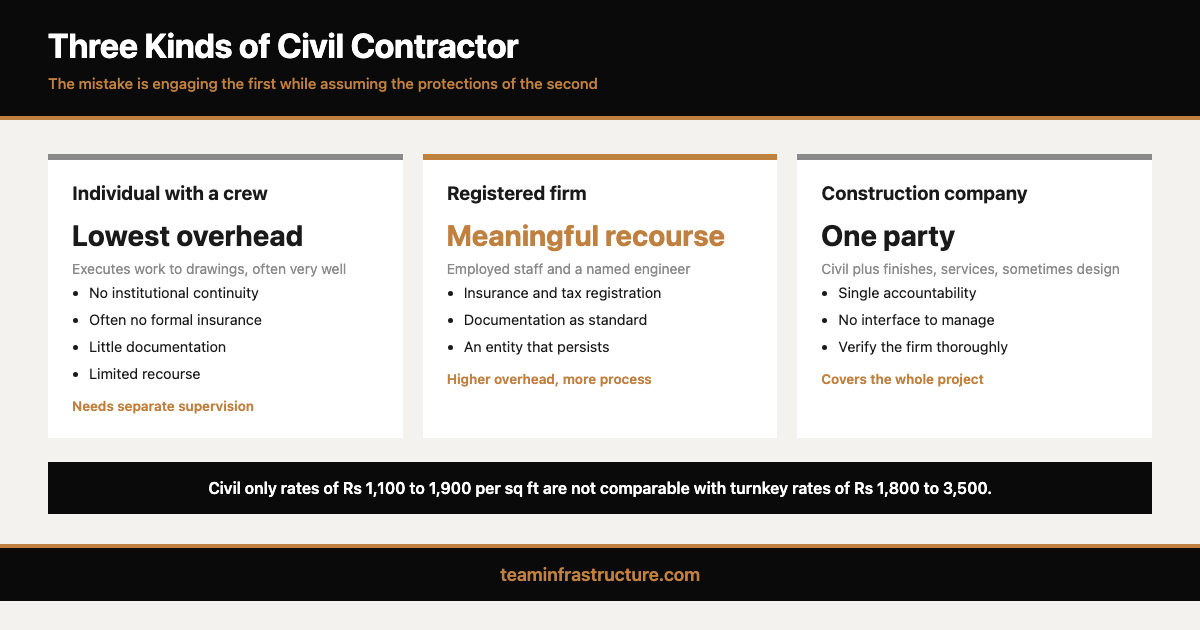
The first three rows are a civil only scope, meaning the building up to plaster with waterproofing, and they are not comparable with a full construction rate. Comparing a civil rate against a turnkey rate is one of the more common confusions in the Kochi market and it makes the civil contractor look far cheaper than the comparison supports. Our guide to per square foot rates and what they exclude covers full rates.
Foundation cost varies most, because it follows ground conditions, and Kochi ground varies from firm laterite to soft coastal deposits to filled land over short distances. Our guide to soil testing and foundation types explains the range.
The Three Categories
An individual contractor with a crew. Executes work to drawings, often extremely well, at the lowest overhead. What is absent is institutional continuity, formal insurance in many cases, documentation, and recourse if something goes wrong. Suitable where an architect or engineer is separately engaged and supervising properly, and where the client is present.
A registered civil contracting firm. Employed staff, a named engineer, insurance, tax registration, documentation, and an entity that persists. Higher overhead, more process, and meaningful recourse.
A full construction company or design build firm. Holds civil work alongside finishes, services and sometimes design, giving one accountable party across the whole project. Our guide to design build versus appointing separately covers the comparison.
None is automatically right. The mistake is engaging the first while assuming the protections of the second.
Selecting One
The checks are the same as for any construction firm and take an afternoon.
Registration documents and a GST number verified on the GST portal. The name and qualifications of the engineer responsible for the structural work. Insurance in date, including workmen's compensation, because civil work carries the highest injury exposure of any trade on a site. Two or three prior client contacts including one project completed over two years ago. A written scope and exclusions list. And a payment schedule tied to verified site stages.
Our guide to the documents to demand before signing covers what each proves, and our wider guide to verifying a builder before you sign sets the exercise in context.
The Four Moments That Decide Quality
Civil work is the part of a house that cannot be inspected later, which makes presence at four specific moments worth more than any clause.
Before the foundation. Was there a soil investigation, and does the foundation design respond to it in writing.
Before every concrete pour. Reinforcement matching the structural drawing in diameter, spacing and lap length, with cover blocks in place holding the steel away from the surface. Inadequate cover is the direct cause of the corrosion that ruins Kerala buildings twenty years on, and it is visible to anyone who looks. Photograph every pour.
During curing. Concrete kept wet for the specified period. Curing costs time rather than money, which is exactly why it gets cut, and a slab dry two days after pouring is telling you something.
Before wet area tiling. Waterproofing complete and flood tested with standing water for 48 hours.
Those four are the whole of practical quality control for a non technical client, and they matter more than the specification document.
Materials and Workmanship Worth Specifying
Civil work is where a specification is either honoured or quietly diluted, and six items account for most of the difference between a good building and an average one.
Concrete grade and mix. Specified by the structural design and not adjustable on site for convenience. Ready mixed concrete brings consistency that site mixing rarely matches, though site conditions and access sometimes make site mixing the only option.
Steel grade, spacing and lap length. All three come from the reinforcement detail. Lap length in particular is where site improvisation happens, because it consumes steel, and a short lap is invisible once poured.
Cover. Covered above and worth repeating, because it is the single most consequential detail in the whole civil scope.
Curing regime. How long and by what method. Specify it, then check it.
Plaster. Mix proportion, thickness and curing. Plaster failure is the origin of most Kerala wall damp, and it is cheap to do properly.
Waterproofing system. Product, the height it is taken up walls, junction detailing, and a witnessed flood test before tiling.
Specify these against the standards published by the Bureau of Indian Standards rather than by brand alone, so that any substitution can be judged on equivalence rather than argued about. Ask also for test certificates for cement and steel, which are ordinary documents in legitimate supply.
One further practice is worth requiring: a fortnightly photographic record of covered work. It costs the contractor almost nothing, and it is decisive in any later question about what was actually built.
Contract and Payment
Payment against verified stages rather than dates, with a modest mobilisation payment and around five percent retained through a defect liability period. A written variation procedure. The drawings listed by number and revision. And an exclusions list, since civil scope boundaries are exactly where disputes arise.
Where the arrangement is labour only, with the client supplying materials, be clear about who provides consumables, scaffolding and binding wire, what happens when the site stops for want of a material, and what wastage allowance is assumed. Our guide to contract types and payment schedules covers the structures.
Site Conditions Around Kochi
Three local factors change civil work in and around Kochi more than anywhere else in the district.
High water table. Common near the backwaters and across much of the low lying city. It complicates excavation, because the hole fills, rules out or restricts basements and deep sumps, and affects both the septic arrangement and any soakaway. It is established by the soil investigation and it should be established before pricing rather than discovered during excavation.
Filled and reclaimed ground. Significant parts of the Kochi area sit on filled land, which looks entirely normal at the surface and behaves very differently below it. Fill is variable and settles unevenly, so the foundation usually has to reach below it or the ground has to be improved.
Restricted urban access. Older parts of the city and the established suburbs have narrow approach roads, which determines whether a transit mixer can reach the pour position. Where it cannot, concrete is either site mixed or transferred, and both change the method, the quality control and the cost. Establish this before accepting a rate, because a contractor who has not visited the site has priced normal access.
All three are assessable in advance and none is a reason to avoid a site. They are reasons to have the site looked at before a number is agreed, since each of them turns into a variation if it is discovered after the contract.
Conclusion
Establish which of the three categories you are engaging, and do not assume the protections of one while paying the rate of another. Get the structural design certified by a named qualified engineer whatever the arrangement. Compare civil rates against civil rates rather than against turnkey ones. Then be on site for the foundation, every pour, the curing and the waterproofing test.
Do that and civil contracting in Kochi is straightforward. To discuss a project, talk to our team in Tripunithura.
Rates are indicative market ranges for Kochi and Ernakulam district as of August 2026 and do not constitute a quotation.
Frequently Asked Questions
What does a civil contractor do?

What do civil contractors charge in Kochi?
Why does a civil rate look so much cheaper than a builder's rate?
Is a civil contractor the same as a construction company?
Who designs the structure?
What insurance should a civil contractor carry?
When should I be on site?
What is inadequate cover and why does it matter?
Should I supply the materials myself?
What should the exclusions list cover?